Sunday, November 22, 2015

Roll20 Characters

I'm getting ready to run a game for some of friends on roll20. I know, I know. Still, it's free.

Because I never do things the easy way, I've made different classes along late-medieval themes and modified the d20 ruleset down to the barest bones possible. I doubt that will interest any randos that stumble across my blog, though.

Class Abilities

Anyway, here are the classes. They have strong, thematic capabilities. These assume you agree with the objectively correct, morally superior position of death to ability scores. They also assume that you receive two feats at first level and rely on them for all of your player-driven character customization. So feats have to be pretty chunky, more like 5e feats than 4e or buy-in 3e. Lastly and perhaps most objectionably, they assume that you don't receive more hit points as you increase in level. If you want that so much, take a feat.

A slow, dangerous melee class.
A defensive melee class. 
A standard-fare ranged caster. I'll probably post their Dark Gift table later, after I de-plagiarize it.

"Let's not fight," you say as you discreetly reach for your sword.
"Ze healing is not as revarding as ze hurting." A non-clerical healing class. I know plague doctors are done to death.
Never stop firing. Also, never stop moving.

Sit in the back row and gank people.

A momentum-based class.


Sunday, November 15, 2015

The Lord Of All Fragments

Vhalkana, his hammer, and his... arm-spikes?

Vhalkana, The Smith-God

Vhalkana was manufactured by the previous smith-god, Cobannos, in an attempt to correct what that deity perceived to be his own weaknesses. Cobannos used all of the best parts of himself as ingredients and died as a result. He omitted various flawed qualities from the new god. Stuff like empathy for mortals, interest in non-smith-related activities, et ceteras. The result is a very hands-on deity.

Vhalkana likes dragooning random mortals to fetch raw materials for him, and not just his worshippers. He sees mortals as a naturally occurring resource much like a lode of mineral ore or a stand of trees. If he needs something they can provide, he will take it.

A typical interaction with Vhalkana might involve him dropping a four-faced angel into the players' vicinity, followed by the angel imperiously ordering the party to retrieve an unusual crafting material from their proximity. Or else. The angel will wait.

Stuff Vhalkana Wants

Things Vhalkana might plausibly demand players fetch:

The Devoted

A priest of the smith-god is known as a "pyraethi", which means fire-keeper. They must be devoid of birth defects, proficient in metalworking, and ideally are descended from another pyraethi. Supposedly, most pyraethi are descended from Vhalkana or Cobannos. After death, they can expect to have their soul collected by their deity, converted to soulsteel or another substance (the better a craftsman the pyraethi was in life, the more rarified a material his soul becomes in death), and incorporated into Vhalkana's next project. For a pyraethi, there can be no greater reward.

The smith-god grants prayers relating to the creation of objects (magical or otherwise), the manipulation and refinement of materials, and protection from destruction or calamity.

Every shrine to the smith-god houses a sacred kiln that contains fire from one of Vhalkana's forges. If it doesn't have a sacred kiln, it isn't a shrine. The fire is continually fed and maintained. Many such fires have burned continuously for hundreds of years or more.

Summoning a wall of shields always helps.

Prayers Of Metal And Making

Create Facsimile (1st-level)

You fabricate a copy of a single common magical item touched. The item is identical in all ways except that it vanishes at the end of the day. You cannot copy the same item more than once on any given day, regardless of how many times you memorize this spell, nor can you copy expendable or charge-based items. [1]

Recharge (1st-level)

This spell attempts to recharge a rod, staff, or wand that has at least 1 charge left. It requires 50 gold in semi-precious stones and rare earth powders. Roll 1d6+1. If you roll a natural 1, your working is flawed and you destroy the object in question. Otherwise you restore the that amount in charges to the item (though not above its inherent maximum, if applicable).

Wall Of Swords (2nd-level)

You conjure a 5x1 wall of spinning blades within short range. The wall blocks line of sight. Each turn, the wall inflicts 1d8 damage to creatures that start their turn within it or enter at least one space of its area. It will not inflict this damage to a given creature more than once, per turn. This wall counts as a friendly creature for the purposes of determining flanking, both for players and enemies.

Wall Of Shields (2nd-level)

You conjure a wall of hovering shields into a 4x4 area within medium range. The zone blocks line of sight to creatures within or past it, imparts +1 AC and AOE resist (half damage) to creatures within it, and counts as a creature for the purposes of determining flanking for both you and your enemies.

Greater Facsimile (3rd-level)

As create facsimile, but for a single uncommon magical item touched. You cannot cast this spell more than once, per day. [2]

Sacred Holocaust (3rd-level)

With a touch, you envelop a foe in agonizing flames. A target touched suffers 4d6 fire damage, Fort half. This is a fire and pain-based effect. On a failed save, they are weak (inflict half damage) until the end of their next turn. On a successful save, this spell is not expended from your memory.

Glassteel (4th-level)

Obviously, the pyraethi can cast glassteel. For them it's probably a 4th-level level spell. I don't know why anybody would think it should be 8th level.

[1] I think the price point for a common item should probably be about 1500gp or less. In Pathfinder, anyways. Basically, the spell should let you clone a +1 weapon or armor.
[2] 4000gp or less.

Notable Pyraethi

Pyraethi Faerzin is the most highly regarded of his order, essentially acting as high priest. He has a dozen four-faced angels working for him and occasionally borrows Vhalkana's forge hammer for personal projects.

Per the direct orders of her deity, Pyraethi Xenia has infiltrated the Yellowcake-Priests. They possess sacred scientific knowledge that mankind is not yet ready to use and are obsessed with destroying the world. Since the world is Vhalkana's -or rather Cobannos'- greatest creation, Xenia is commanded to destroy them. She has forged a marvelous helmet that allows her to eavesdrop on their communications with the star that they serve, permitting her to pretend to be one of their number and to infiltrate their ridiculous floating pyramid. She feels like she is operating on borrowed time and will escape as soon as conveniently possible.

Though not the most powerful of spellcasters, Pyraethi Jasparo has bred a sacred goose that lays eggs of the purest iron ore. He guards it like one in the throes of a deeply insane paranoia. Unbeknownst to Jasparo, the goose also exhales fumes of concentrated mercury.

Several pyraethi cooperate at Yesh Barit, the sacred foundry. All manner of projects are carried out here under the direct supervision of Vhalkana's angels. Their chief task is refining orichalcum, used for divine armaments such as thunderbolts, and panchaloha, a chameleonic idol-metal sometimes used by the gods in the manufacture of living creatures.

The Fire Caravan

Now that is a cool-ass mineral. It's moldavite, found exclusively at meteor impact sites.
The Fire Caravan is a troupe of ten or so pyraethi that wander the world in search of thokcha, also known as meteoric iron. They pay top-dollar for documentation of recent meteor activity or stories about meteor fields. They eventually turn all of their findings over to Vhalkana, but also perform their own experiments on samples prior to handing them over. They probably have all manner of void-kissed substances.

Stuff like:

  • Armaments glazed with void-rust scrapings. They are forbidden from using the void-kissed meteoric iron, itself, but surely the forge-god will not begrudge his followers a little bit of rust. The priests are getting quite clever at working with it.
  • Spun objects of ultra-frozen primum frigidum that will never melt. Useful for, uh, well. Maybe they're unbreakable? I could see laminating some sort of ice-themed armor with it, or alloying it with an igneous mineral to make some sort of fire/ice super sword.
  • Superconductive wands (superconductive to electricity, magic, or emotion, depending).
  • Metals that convert into dangerous organic matter when contacted with water. They could probably use this to grow you a new limb or organ. Assuming you didn't mind it being hideous and unrecognizably alien.
  • A portal stone that permits instantaneous travel between worlds. The sender is waiting for somebody to activate it so they can come through. This would probably lead to undesirable outcomes.
  • An Eye of the Star-thing. Whatever it is, it grew uncountable millions of extra eyes, attached each to a stone capable of surviving atmospheric entry, and hurled them at an unfathomable number of worlds. This is probably one of those "when you gaze into the darkness, it gazes also into you" situations, so I wouldn't get too cozy with the eye. Maybe it could give you a bonus when casting contact other plane.
  • More moldavite than you can shake a fist at. I'm sure it possesses amazing properties for magic or spellcraft. Maybe allow it to reduce the price of crafting plausible magic items?
This is basically what I think an Eye Of The Star-Thing should look like.

Thursday, November 12, 2015

The Tias: Soulbound Gems As Magical Keepsakes


tldr; there are dozens of magical gemstones, each with a soul-bound princess trapped inside of them. Each conveys a small bonus, while collecting several conveys a cumulative set bonus.

The Ishnindah is not one of history's actors. She lurks in the background, plying her trade with the stoic fools of each era. Her footprints stretch across millennia, backwards and forwards.

Though she has lately preferred body parts as payment, there was a time when she preferred maidens of royal extraction. Want a spell that causes an enemy to only gain nutrition from cannibalism? Turn over a princess. The Internal Struggles of three centuries ago were largely an arms race of purchasing death-hexes from the Ishnindah. The royal families of the great cities mined their extended family trees for suitable candidates, turning them over by the dozen. Much magical lore was accrued from these transactions (the Ishnindah's well of magic does not run dry), though it was largely destroyed later, when the faith of the Idolatrous Lords waxed supreme.

The Witching Ways
The Ishnindah confounds analysis. But we know very well what happened to the princesses given over to her: their soul were trapped in gemstones, used to power their magics. There are at least fifty of them, each made by the Ishnindah and traded away. Over the centuries they have fallen into the hands of many adventurers and monster troves. In my game there is a flat 5% chance per incidence of treasure that a tia is among them.

The gemstones are called "tias". Keeping them in your possession only counts as one magical item, total. I use a trinket slot. If you use the absurdly granular Pathfinder 17+ item slot system, please stop. If you persist, maybe use the amulet slot.

The Tia Stones

Each tia stone conveys a small magical bonus, while the total number of tias equipped by a character conveys a cumulative "set bonus".

Set Bonuses (total mumber of tias: bonus)
  • 3: You have resistance (half damage) against acid and poison.
  • 5: You have +1 to all of your saving throws.
  • 10: Your spells inflict +1 damage.
  • 20: +2 to all saving throws.
  • 35: Your spells inflict +2 damage. 
  • 50: You cease aging, gain +3 to all saving throws, and can infallibly detect lies and detect magic as per those spells.
Individual Stones

I really dug deep for these t-named gemstones. You should come up with your own, too.
  • Tia Topaz: You heal 1d6 hit points from healing spells of 1st-level or higher.
  • Tia Tigerseye: You have a +4 bonus to Sense Motive checks.
  • Tia Turitella: You are immune to slow and similar effects.
  • Tia Tanzanite: You have resistance (half damage) against electricity.
  • Tia Tourmaline: You can cast cure light wounds twice per day.
  • Tia Titanite: You can cast a weak version of dimension door, once per day. It functions as the normal spell, but with a range of only 100 feet.
  • Tia Tektite: You ignore the first incidence of ability score damage, each day. If that doesn't match your rules set, it instead makes the player immune to the first debuff to affect them, each day.
  • Tia Tortoiseshell: You have +1 AC.
  • Tia Turquoise: Outsiders and spirits have disadvantage when attacking you.
  • Tia Tsavorite: You have resistance (half damage) against attacks of opportunity.
  • Tia Thomsonite: You have +3 initiative.
  • Tia Tugtupite: You are immune to bleeding effects. You have +5 max hp.
  • Tia Taaffeite: You can cast meld into stone once per day.
  • Tia Tinaksite: You are immune to damage and suffocation from non-magical heat and fire. For the purposes of this tia, magma and other geothermic heat is magical.
  • Tia Tyuyamunite: You shed a ghostly green light within a short radius. You are immune to blindness, magical or otherwise. If, for example, your eyes were gouged out, you could still see so long as you had this tia.
  • Tia Tsumebite: You can see through barriers of 1 inch thickness or less, including fog and many doors. You can't see through lead or other unusually dense materials, though.
  • Tia Tsumcorite: You are immune to color spray, prismatic spray, and any other "color-based" spell. You have +2 speed.
  • Tia Trona: Your fire spells inflict +1d6 damage.
  • Tia Triphylite: You cannot be knocked prone.
  • Tia Tridymite: You do not suffer any ill effects from excessive atmospheric pressure or the lack thereof. You are immune to decompression sickness. You can also hold your breath for up to a week.
  • Tia Tremolite: You have fire resistance (half damage).

Tuesday, November 10, 2015

The Koros

A Koros bird-lancer.
The Koros are a race of barbarous, nomadic bird-riders. They reside in great numbers at the grasslands of Arhelia, where they and their vast herds of bird-horses live, fight, and reproduce. The lands of the Koros are vast and their internal struggles significant, but when a powerful leader emerges the Koros are willing to gather in great hordes and ride against the degenerate cities-states of their region of the world.

The Koros are polygamists. Koros men are expected to have at least three wives, each of whom will birth as many children as possible. There is also a well-established tradition allowing for women that are successful warriors to be treated similarly to men, including retaining numerous wives.

Portrait Of A Bird-Lancer

A Koros warrior typically owns two well-trained bird-horses, a steel-tipped riding spear, a bronze sword for close-quarters fighting, a quiver of filth-smeared javelins, a suit of reinforced leather armor (perhaps incorporating a breastplate if they are wealthy), a pouch of antiseptic salts, decorative bones taken from slain foes or lovers, and feathers from long-dead mounts. Though not an especially inventive people, their bird-horse kit includes stirrups (an innovation other cultures have yet to value).

Successful warriors are rewarded by ritually inscribed tattoos that protect them from various harms. They may include any or all of the following:

  • Whorl Against Witchcraft: The Koros has advantage when saving against spells of all kinds. This is the most commonly found tattoo.
  • Whorl Against Disaster: The warrior never accidentally drops or breaks their spear. They cannot botch.
  • Whorl Against Cowardice: The warrior is immune to fear and being slowed, and their mount has +2 speed.
  • Whorl Against Weakness: The Koros inflicts an extra +1d6 damage with a charge attack. They are also immune to most diseases.
Some Koros also procure flasks of blessed water, to be sprinkled over a troop of cavalry and imparting resistance (half damage) against ranged and AOE attacks for an hour or so.

Riding Birds

Every Koros bird-knight can use their mount to leap over 20 feet in a single bound, aiming their lance with the full weight of their mount behind it. Such an attack is devastating, probably inflicting double damage.

The bird-horses are quite dangerous on their own. Their claws can disembowel an armored man. A pecking bird-horse can easily crush a man's skull or rip the flesh off a limb. Skilled riders will incorporate their bird's natural talents into their combat routine.

The Taboos Of The Bird-Tribes

They have many taboos. The most important:
  1. Bodies must be brought to the gates of the afterlife. The gate is located in the ruins of an ancient temple in the center of Arhelia. To die and not be sent through the gates is to consign your soul to inflict grief upon your descendants. As I discuss elsewhere, this particular belief eventually results in a great deal of trouble.
  2. Digging in the soil is what farmers do. Do you want to be a slave to the land? I didn't think so. Do not ever dig in the soil. For that matter, most work unrelated to bird husbandry is beneath a proper Koros.
  3. The word for magic that is not bird-shaman magic is witchcraft. Witches must be killed.

Thursday, November 5, 2015

Motes Of Unlight

A nearly full gloom lamp, used to harvest unlight.
Unlight is a poisonous, bewildering form of mostly-undiscovered energy that permeates our reality. The metaphysical properties of this energy are poorly understood. Indeed, many a careful wizard has ruined their experiment with unexpected (and violent!) interactions with minute amounts of unlight. Like an ant frying under a magnifying glass, the wizard wouldn't have any idea what went wrong.

You can't see unlight under normal circumstances. It just isn't concentrated enough for the eye to detect it. Most adventurers only see it when somebody casts a darkness spell. Even that involves only a minute amount of unlight, just enough to repel the photons in the area affected. More concentrated motes of unlight will drift about like water in zero gravity, unaffected by wind, breaking apart into wisps of inky darkness. Any solid matter that touches unlight is stained black and oxidated, resulting in the destruction or at least ruin of most nonmagical objects.

Sources Of Unlight

Unlight seems to exist nearly everywhere, at least in very small amounts. The few intrepid wizards that know about the energy have detected the strange emanations under every circumstance imaginable. Some suspect that unlight is an unknown form of the negative energy that provides motive force to undead, or at least related to it. No experiment has yet proven this.

The more concentrated forms of unlight are occasionally found in nature: adult phase spider venom contains a high concentration. Certain wraiths seem to leave a trail of it and emit a particularly large burst when slain. I suppose a sufficiently dedicated wizard could farm wraiths by feeding people to them (wraiths usually transform their victims into more of the same). I can't imagine that having a happy ending.

If your campaign has some sort of primordial creature from the outer darkness that existed before creation, it's likely suffused with or even the source of unlight. It may have left behind nodes of the stuff in temples or forgotten places.

If you talk to the right djinn, it can explain how to make a a lead-lined "gloom lamp" that will slowly accumulate unlight over time. A night hag could probably sell you a canister of the stuff, as could the Ishnindah.

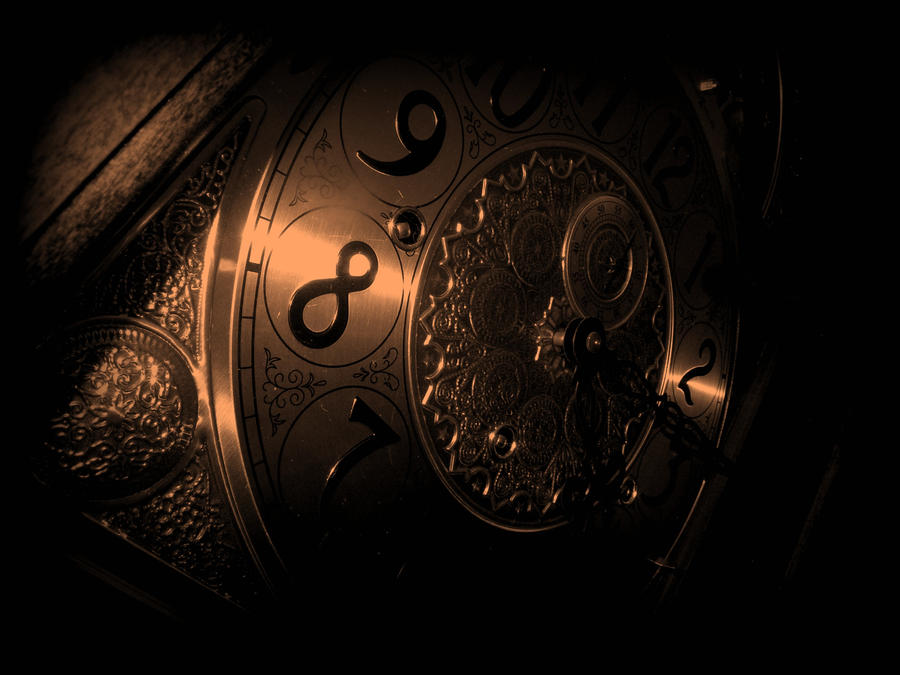
A drear clock keeps perfect time.
Of Strange Utility

Okay, there's this weird energy that's kind of everywhere. But what can you do with it? Aside from transform fungal or arachnid creatures into true horrors. Well, there's always magic items.

Night-Stained Armor

If you bathe a suit of armor (leather, metal, whatever) in unlight enough times (alternated with mending spells to keep the suit from being destroyed), it will become the color of squid ink and feel noticeably chilled to the touch. Such armor renders the wearer invisible (as the spell) to creatures more than 30 feet away so long as one remains motionless.

Noculator Zombie

If you can stabilize liquescent unlight (not too difficult for a spellcaster of 5th level or higher), it is possible to transfuse it into the inert circulatory system of a zombie. Such a zombie has resistance against fire (half damage), +2 to their speed, and is invisible when more than 30 feet away from a creature. The zombie will dissolve after a month or two.

Drear Clock

One can craft a remarkably accurate clock powered by a leaden chamber full of unlight. Such a clock keeps perfect time (rare in a medieval society) and only needs refueling once a century. For reasons that are unclear, the clock enrages any good-aligned outsiders that notice it. Such a creature must succeed at a Will save or immediately seek to destroy it. The clock doesn't radiate evil or anything, the outsiders seemingly can't help or explain themselves. More usefully, divination is difficult near the clock. Divination spells of 5th level or lower cast within 100 feet of the clock or targeting within that vicinity simply fail to function.

Gloomstones

A suitable refractory stone (spinels work well) that bathes in the interior of a gloom lamp for a few days will transform into a glittery black stone that seems to shimmer constantly. It's difficult to look at and trying for too long will give you a headache. Aside from jewelry, wizards like to crush gloomstones into gloom dust and snort it. It doubles the range of all darkness-related and shadow-related spells. Spinels are kind of expensive (they are probably considered rubies in your game world), so it probably consumes about 50gp of dust per casting, assuming you already have access to unlight.

Gloomstones!
Inherent Risk

Any or all of the issues below might affect characters handling or exposed to unlight.

•Creatures that are exposed to unlight lose a day off their natural lifespan per day exposed to the stuff. In essence, you age twice as fast. Their bodies do not visible age, they just stop early.

•Overfull gloom lamps have a nasty habit of going critical. If you forget to empty one for more than three weeks, it will sit there fuming out little tendrils of darkness until somebody actually touches it. Then it will explode, sending shards of lamp everywhere (3d6 damage, Reflex half), 2d6 cold damage, and causing them to suffer the effects of a nightmare spell as though it were cast on them each night, for 1d8 nights. During this period, the player also ceases healing naturally.

•A creature foolish enough to consume unlight will die a terrible death. The immediate effects will include terrible chills radiating throughout their circulatory system and blindness (the eyes turn entirely black, and may dissolve completely). After a day or two, the body will boil off into strands of cobweb.

•Touching concentrated unlight will stain skin for a year and a day. If wizards were more involved in the criminal justice system, I could see this being a decent way to mark criminals.