Friday, October 9, 2015

The Void-Soaked Mummies Of The Broken Dome

An advanced Arha noble from the postclassic era of their culture.
A City Amongst The Stars

Once upon a time, there was a civilization of wizards so powerful that they could hang their cities amongst the stars. Well, not really amongst the stars. More like amongst the Lagrange points in upper orbit around their world (your campaign world).

They encased their orbital cities in domes of glassteel on captured asteroids, locked them tidally, set up self-contained ecosystems with magically generated gravity, and devised permanent teleportation circles to allow easy passage to and from their manmade paradises. It worked quite well for several hundred years. Any time the orbital cities were threatened, they would simply roll a stone imbued with anti-magic over their end of the teleportation circle and wait it out. No teleportation circle meant no access to the city. It was an uncrossable moat.

Their problems were internal in nature. Bathed as they were in cosmic radiation, most children born in Arha exhibited deformities or mutation. In time, these mutations came to be highly prized by the inhabitants. Only the more normal-seeming Arha would interact with the people of the planet below, while the most inhuman Arha would remain in their city as its rulers.

Another significant issue would prove to be the city's undoing: the loss of magical expertise over time. The Arha retained great troves of their ancestors' knowledge, including how to make and repair the city's glassteel dome, but their warped physiologies became steadily less equipped to make use of it. Still, so long as they controlled the teleportation circle, nothing could threaten them from below.

A Soft Civilization Meets Hard Vacuum

Eventually, one of the orbital cities pissed off the wrong wizard. Maybe he was exiled from their midst for his lack of mutation and consequently had a better than usual understanding of the location of his city. Maybe he was just really smart. In any case, he devised and successfully prosecuted a method of piercing the glassteel dome surrounding the city known as Arha: he summoned a byakhee, rode it up to the city, managed with some difficulty to match its velocity and land, and thence disintegrated a significant swath of the dome.

The end came quickly: the atmosphere rushed out before most inhabitants could react. A few managed to escape through the teleportation sphere or by other means. Though the city boasted many precautions against this very event, including hermetically sealable buildings and so forth, most were long forgotten or in general disrepair. In any case, the magical acumen necessary to create glassteel was no longer present and repairing the dome without that would be impossible. The city went quiet and dark, a floating tomb.
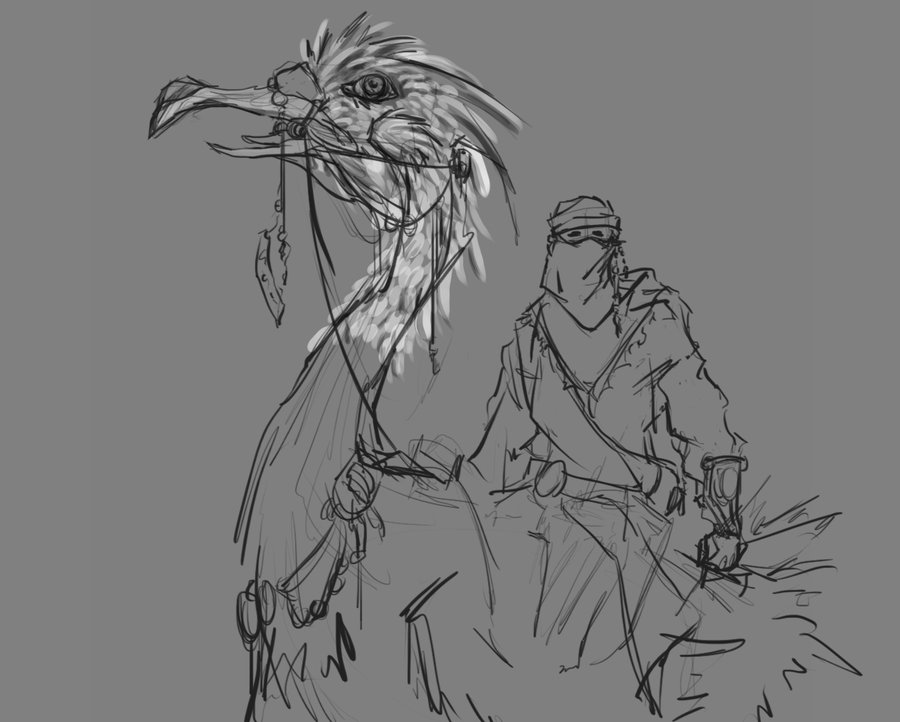
A Koros bird-lancer scans the horizon for foes.
Enter The Koros

Eventually, knowledge of Arha was lost to the surface-dwellers and largely forgotten by the other orbital cities (who by now had their own problems to contend with). The Koros, a race of barbarous bird-riders, came to dominate the area around the planet-end of the portal.

The magic of the teleportation circle was quite beyond their limited arcane understanding. They knew only that anything that entered the area of the circle disappeared, never to be seen again. Eventually, the circle was incorporated into their religion. Bodies were lavishly prepared, festooned with such modest finery as their people could afford, and ritually placed into the circle.

As a nomadic, non-agricultural people already disinclined to sow seeds or waste wood on a funeral pyre, the ritual casting of corpses into the circle allowed them to totalize their taboo against digging in the soil. After nearly three centuries, the only acceptable means of corpse disposal is to deposit it into the circle.

Meanwhile, the bodies piled up in Arha. The same magical precautions taken to prevent teleporters from superimposing their bodies over air molecules also prevented the corpses from occupying the same space. New corpses landed atop a vast pyramid of vacuum-desiccated cadavers.

A little bit about the Koros: each man of the Koros takes at least three wives. Each of these wives can expect to have five or six children, of whom perhaps half will survive to adulthood. All of these that leave recognizable remains will be taken to the teleportation circle and deposited within. By the current century, there were hundreds of thousands of cadavers up there, lying quiescent and perfectly preserved by exposure to hard vacuum, just waiting for somebody to find them.

Welcome, Necromancer

Eventually, the Necromancer came. The Koros tried to kill the obvious witch with their spears, as is proper in their culture. Their herbal tinctures that normally proved so effective at warding off magic did little against his swarm of animastrictor skelesnakes. It took him less than a month to killed everybody who might object to him declaring himself god-king of the Koros. He was the right person at the right time.

One big thing the Necromancer noticed very quickly is that there were not any graveyards or even particularized pyre-ash around. He's very in tune with these things, and would notice if they were there.  Eventually, he got around to asking about it. The Koros explained. The Necromancer found the circle, sent a ghoul through the circle and back, and eventually figured out that the other side lacked pressure or atmosphere.

Natural physics are not usually in the Necromancer's wheelhouse, but he still managed to devise and construct a primitive bathysphere. With his zombies carrying it about, he has explored the ruined city of Arha. What a magnificent discovery! What a wonder! What a necromantic tinderbox just waiting for a negative energy spark!

The circle led to the perfectly preserved corpses of two whole cultures: the relatively small number of Arha and the vast heap of Koros. Animating them would become the Necromancer's magnum opus.

A Koros mummy that has soaked in cosmic energy.
Things From The Broken Dome

The mutant corpses of the dead Arha possess many characteristics that make for powerful undead: extra limbs, maws in their torsos that whisper unspeakable secrets even in death, gravimetric muscles that allow limited telekinesis, and so forth.

Nor are the Koros mummies entirely devoid of interest: bathing in cosmic radiation for centuries has imbued many of them with a smattering of strange qualities: polychromatic auras that becloud the mind, achrononistic ways of interacting with time that allow them to blink in and out of existence, claws dripping with void-ichor, and so forth.

Nor is the dome solely a necromantic treasure. The Arha were a wealthy people, their coffers filled from selling maps and intelligence gleaned from telescopes and their orbital vista. They also possessed a goodly number of magical objects inherited from their ancestors. There are batteries containing raw sunstuff, rings that allow soaring through the air, and more.

There is also the Nullification Stone, a 3-foot sphere of stone that nullifies magic (as an anti-magic field) in a 5-foot radius. According to my math, a 3-foot sphere of granite weights over 19,000 pounds. I have no idea how the Necromancer would use this or what kind of special undead creature he might design to house and wield it, but I'm sure you can come up with something.

Other trinkets include "exo-bracelets" that allow survival in a vacuum (lying forgotten in a vault), ioun stones that reduce your need to consume food by an order of magnitude, and damier-print cloaks that halve damage from projectiles via inertia manipulation. There are also scrolls detailing astrophysics and primitive spelljammer ship deck plans.

Perhaps most perilously, the Arha libraries include well-encoded books describing the rituals necessary to snare a large asteroid and maneuver it into proximity with your campaign world. The ritual poses an existential threat to humanity should it ever fall into incompetent or malicious hands. The Necromancer doesn't need it and might just sell it (perhaps to the Ishnindah).

A Dark Future

Conquering the world seems so plebeian, but that's mostly because nobody ever manages to do it. Actually conquering the world or even just a significant portion of it seems pretty appealing, particularly if you have the means to achieve it. When you have a hammer, everything looks like a nail. An undead army numbering in the hundreds of thousands will probably suffice for at least a continent.

The Necromancer has the Koros, too, who are largely immune to magic (though not to summoned or animated creatures). Their bird-horses make for agile, deadly cavalry, leaping into the air for twenty feet at a time and crashing down onto enemy troop formations. The Koros have decided that the Necromancer is the sacred representative of the afterlife. After all, he has completely mastered the power of the teleportation circle that leads there. He is even capable of returning things from the other side!

Really, the only plausible force for stopping the Necromancer's army would be some kind of crusader order capable of dealing with diverse undead menaces. Which is where the Koros come in: if the Necromancer gets even a whiff of paladins, he'll dispatch a hundred bird-lancers to take care of the problem. Or a thousand. Or ten thousand (there are a lot of Koros). This meshes pretty well with their values, they've always wanted to conquer and destroy the decadent soil-cultivating cultures that sprawl across the world, but largely lacked the means. Until now.

I'm sure you can take it from here. Good luck with all that, player-characters.

Tuesday, October 6, 2015

Vṛtra's Saliva (An Alchemical Process Involving A Series Of Crystal Spheres)

A sphere begins to fill with moon drops.

Shrendek, Chapter Seven

If you are a magus in possession of a copy of the Shrendek Manuscript, you would be well-advised to avoid chapter seven. It describes a simple process to procure pure droplets of moonlight, a supernatural substance possessed of many wondrous properties. The ritual is easy enough: after an inexpensive ceremony invoking aerial spirits, a series of hermetically sealed glass spheres fills with a mysterious fluid, milky and luminescent. The fluid boils down to a few so-called moon drops. This would not in and of itself be problematic, except that the moon drops are actually the reality-corroding saliva of an otherwordly obscenity.

The Unfortunate Truth

Though their invocation is unfamiliar enough to fool most wizards, the aerials invoked in the first part of this spell do not exist. If a second party has a detect magic spell active, they will note that nothing supernatural is occurring during the process. The second portion is more strange: it seems to be a naturally occurring para-scientific process for a series of hermetically sealed glass spheres to fill with this liquid. Any time correctly-designed glass spheres are arranged correctly, they will eventually produce moon drops, ritual or no.

Moon Drops

This strange substance has all manner of applications: it dissolves most non-living materials (alchemically treated glass seems to be the exception, though if concentrated it will also dissolve that), it reduces the spiritual damage caused by revivifying spells (half XP loss, perhaps), consuming a highly diluted portion of it allows a limited form of prescience, and it is useful in the manufacture of magical armaments. Most interestingly, the drops prolong the natural lifespans of toads and other amphibians by a seemingly indefinite duration. Given some time and effort, a bright wizard might modify the drops (or even themselves) to achieve a sort of immortality. Alas, wizards who investigate that possibility tend to meet their end rather soon.

The Poisonous Multiverse

We live in one universe amidst a multiplicity of possible universes, wending this way and that. Most of those universes are filled entirely with moon drops. The drops drip down the sides of all possible universes seeking the tiniest of cracks. Slowly, slowly, the drops fill that reality, dissolving bits here and there before boiling off.

If an enterprising wizard creates more than a gallon or so of the stuff is in one place, though, something strange happens: the droplets will collapse into a single point, creating a puncture wound in the continuity of the universe. This puncture manifests as a slowly expanding pinprick-sized portal, called a lacuna, that emits a constant stream of more powerfully concentrated moon drops. These drops will dissolve even the treated glass that can normally be used to contain the drops. Indeed, they will dissolve anything.

The lacuna doubles in size, each day, streaming corrosive moon drops in a steadily increasing stream. After approximately thirty days of unchecked expansion, the portal will be sufficiently sizable for a Fang of Vṛtra to enter.


Like this but with a thousand limbs.

A Critical Mass

The Fang is terrible. It resembles a toad with a hundred limbs, topped by a great maw that spews great geysers of moon drops. It is fast, can perceive everything that occurs within a mile of it, and is capable of puissant probability manipulation. It grows rapidly, eventually approaching the size of a castle. The creature squeezes through the lacuna, awash in moon drops and rabidly destructive.

A Fang can usually kill tens of thousands of people and desolate the surface of a small kingdom before it is eventually worn down and destroyed by the waves of adventurers and servants of the gods sent against it. Even disposing of the corpse is a difficult task: it must be mixed with thousands of pounds of salt, consecrated, and burned. Otherwise, it will return to life within a day or two.

A month or so after the first Fang enters the universe, another emerges. The next in just a two weeks, with the time lapse halving after each further emergence. Eventually, a Fang will emerge from the lacuna every few seconds. For all practical purposes Vṛtra has an infinite number of Fangs.

Closing The Hole

No known process can close the lacuna. If a clever spellcaster were able to somehow craft a concentric series of orichalcum-glazed glass around it despite its continual acidic emission, it would considerably slow down the speed of expansion, making the emergence of the first Fang something that will happen in a decade rather than month. The gods and their servants seem unable to close it, perhaps because even a god cannot affect universes other than that in which they reside. Wishes might allow one to travel through time and prevent the lacuna from opening, but cannot themselves close a lacuna.

Dealing With It

Necessarily, moon drops do not dissolve the Fang or it's bodily materials. It is therefore possible to use the materials of the Fang's hide to fashion equipment capable of withstanding the exposure. It's not entirely impossible to make off with one of the creature's limbs while it is distracted, to treat the skin with a wash of magma or other extreme heat, and return to the creature bearing armor capable of withstanding it's venom. That ought to make killing them easier and buy the players some leeway.

The Fang-hide can also be used to handle newly created moon drops. I suppose it is possible that the players could devise some sort of hidebound pipe to stretch from the lacuna to a portal to still another world, though I doubt that world would thank them. In any event, this merely delays a symptom of the true problem.

Terminal Velocity

The lacuna will not stop expanding. Eventually, the mass of moondrops will exceed that of the planet where it is located. If any of the planet even remains by that point. The actual moon will be drawn into the drops, dissolving in a rush of foaming rock. Some time after this, the drops themselves will begin congealing into more Fangs of Vṛtra, adding to those still streaming endlessly through the lacuna.

Given still more time, long past the point where intelligent life is possible, the moon drops will fill the entirety of creation's space, swelling it like a pustule, swarming with an impossibly large number of Fangs, ready to bleed over into the next reality. Indeed, this is what is encountered if some enterprising soul devises and implements a plan to enter the lacuna to investigate the far side: an endless, universe-sized ocean of universal solvent, swarmed by Fangs of Vṛtra.

Hit It And Quit

Really, the only hope your players have is planar evacuation. They certainly can't kill Vṛtra, whose unspeakable bulk stretches across an uncountable number universes, leaving no room even for the laws of physics to function there.

Well, I hear the outer planes are lovely this time of year.

Saturday, September 26, 2015

The Jek

A marrow river runs through these Jek hills.
The Jek inhabited this land when it was young. Identifiably Jek objects show up in the deepest mines of every country on this continent. Their ancient trinkets wash ashore on beaches and the shores of the deepest lakes. When Karanok, the great mountain, erupted and concealed the sun for a year, fire-impervious Jek statues were carried up amidst the pyroclastic flow. In short, we know that the Jek have existed for a long, long time. But they are absent from recorded history. Why?

According to the priests (who asked the gods) the Jek were driven beneath the earth by a storm that did not end for a thousand years. The priests do not say what happened in the deep tunnels. But the wizards do: the Jek found and paid obeisance to strange spirits: Cave Owl, Moon Centipede, and others. Perhaps they worshipped these spirits before they were driven below, and the gods sent the never-ending storm to punish them for it. Perhaps not. Did the spirits make the Jek mad and evil, or was it the other way around?
Jek initiates perform an unknown ritual.
The Jek revere their shamans. Without the shamans, the Jek would starve. At some point during their time below, a spirit taught the Jek shamans to vomit a vast, roiling pool of edible putrescence. The Jek subsisted on this for thousands of years. Now, they cannot digest anything else. When a shaman announces that the feast is immanent, it is a cause for great celebration: entire tribes will organize their receptacles to catch the revolting spew, dancing and singing with gladness.

Entire rivers of a similarly emitted (though less nutritious) substance course over the Jek lands, most resembling oily eddies of pale, liquescent bone marrow.

As a people, the Jek appear to be disfigured albinos. Their skins are covered with sores.  Many Jek lack fully-formed faces. Their shamans always wear masks. Beneath these masks, the shamans have no discernible features at all. Despite this, they are capable of respiring, speech, devouring the bodies of deceased humans for their own shamanic potions (but never anything else), and expelling the questionable foodstuff mentioned above.

Most Jek live in shallow caves or in the trunks of great trees, though there are a few Jek cities. These cities are mobile: every structure in them is carried or dragged by either the Jek or some sort of creature cultivated by them. Their greatest city, Tlel Washke, is built atop a vast stone slab that is chained to the towering reanimated corpse of Washke, who once styled himself to be the king of giants. Tlel Washke is dragged across the ground by this festering ex-king, following a nonlinear path according to the Jeks' inscrutable wishes.

The Jek do not have much in the way of appreciable metallurgy. They weave baskets and clothes, carve statues and render them indestructible, make amulets, and build strange dwellings from wood and stone and cloth.  The shamans produce a certain number of finishing goods by devouring humans and then regurgitating that material in a new form. For example, Jek swords consist of impossibly intricate human scrimshaw. A tribe preparing for war will feed dozens of prisoners to their shamans, each day, while those shamans laboriously vomit up sword after sword with seemingly no limit to the amount of material they can store inside their person. The Jek do not possess a written language, nor do they seem capable of learning one.

Near Jek, things are not as they should be. Their presence causes dreams to superimpose over reality. Large groups of Jek often appear to have the same face. Water droplets rain upwards from pools and rivers into the yawning sky. Birds cry out dire warnings in diverse languages.

A Jek emissary might appear as your best friend, you, a deceased pet from your childhood, or a horrid shimmering image in your dreams. The message relayed will not make sense. However, the Jek's intent will be obvious: hostility.

Saturday, September 19, 2015

The Four-Faced Angels


Quadriphonsical antagonist or condescending passerby? You decide. Either way, the self-proclaimed forge god wants his piece. He also probably wants to replace humanity with these things, but doesn't have the divine clout.

Sunday, September 13, 2015

Random Magical Breakthrough Table

A bleary-eyed Xag-Ya emerges from a set of catoptromantic mirrors that your
wizard invented by accident.
A wizard in your game is researching spells or trying to make a magical item. Or, I dunno, researching some aspect of the Dreams Of Ruin. They fail at whatever they were attempting, but as the DM you want them to have discovered something. "Nothing" is the most boring result possible from any game mechanic.

Polish off that d8 and give the players something to chew on:
  1. A simple recipe for spontaneous generation. The animal should be something like a toad or a lagomorph, and the ingredients should involve stuff like bundles of rotten reeds, salt, and moonlight. The recipes only require 1d4 hours per batch of 2d20 varmints.
  2. A simple method for condensing 1 hit die skeletons into the shape of an oversized bone arrow. The process costs about 10 gold, but it produces an arrow that will unfold into a very angry skeleton. Could it be helpful for sieges? Probably not!
  3. A weird variation of a spell that the player already has. Ad hoc choose what you perceive to be the player's favorite damage spell, then change the damage type (this version does electric damage) and tell the player that every time they cast it, they teleport 10 feet in addition to the usual effects.
  4. The wizard invents a musical note that shatters wood. If they are a plausible vocalist, they can shatter a single board with their voice. With a specially designed dungchen they could probably bust down a door.
  5. Hurray! The wizard discovers a questionable application of the third homeopathic principle. They can now dilute a 1d8+5 healing potion into two 1d6+1 healing potions. I assume your potions heal different amounts than in my campaign, so tweak the numbers. Remember that it's only kind of an innovation.
  6. The wizard designs schematics for a set of catoptromantic mirrors. They would cost about 300 gold pieces in my game, and be useful for increasing the range of divination spells. An interesting and definitely unintended feature of these mirrors is that a xag-ya will emerge from them every 1d4 days and wander around for a bit before zipping back into the mirrors. A xag-ya might have some application with magic item creation (who wouldn't want a sword with one of these trapped in it) or powering an improbable wizard project of some sort (they are basically sentient batteries). An interested wizard with these schematics could probably spend a few weeks designing a set of obsidian mirrors that would produce xag-yi instead of xag-ya. One thing is for sure: xag-yi and xag-ya fucking hate each other.
  7. The wizard discovers a better way to cast an existing spell. Arbitrarily choose a spell that you think is too high level for what it does and tell the wizard they can memorize it as though it were a level lower. For example, based on my reading the tiny hut spell (a 3rd-level spell) is much, much worse than rope trick (a 2nd-level spell). I might tell the wizard that they have discovered a way to cast tiny hut as a 1st-level spell. Seriously, what is up with that spell?
  8. Birds are incredibly receptive to sympathetic magic. The wizard realizes that if they cast their spells just so, a number of game birds equal to the spell level expended will be summoned.

Thursday, September 10, 2015

The Shadow of the Torturer


“I was sitting there, as I said, and had been for several watches, when it came to me that I was reading no longer. For some time I was hard put to say what I had been doing. When I tried, I could only think of certain odors and textures and colors that seemed to have no connection with anything discussed in the volume I held. At last I realized that instead of reading it, I had been observing it as a physical object. The red I recalled came from the ribbon sewn to the headband so that I might mark my place. The texture that tickled my fingers still was that of the paper in which the book was printed. The smell in my nostrils was old leather, still wearing the traces of birch oil. It was only then, when I saw the books themselves, when I began to understand their care.”

His grip on my shoulder tightened. “We have books here bound in the hides of echidnes, krakens, and beasts so long extinct that those whose studies they are, are for the most part of the opinion that no trace of them survives unfossilized. We have books bound wholly in metals of unknown alloy, and books whose bindings are covered with the thickest gems. We have books cased in perfumed woods shipped across the inconceivable gulf between creations—books doubly precious because no one on Urth can read them.”

“We have books whose papers are matted of plants from which spring curious alkaloids, so that the reader, in turning their pages, is taken unaware by bizarre fantasies and chimeric dreams. Books whose pages are not paper at all, but delicate wafers of white jade, ivory, and shell; books too whose leaves are the desiccated leaves of unknown plants. Books we have also that are not books at all to the eye: scrolls and tablets and recordings on a hundred different substances. There is a cube of crystal here—though I can no longer tell you where—no larger than the ball of your thumb that contains more books than the library itself does. Though a harlot might dangle it from one ear for an ornament, there are not volumes enough in the world to counterweight the other.”

― Gene Wolfe, The Shadow of the Torturer

Tuesday, September 1, 2015

The Sun Devourers

Click for a larger version, friend!
I really, really like these guys. It's just a basic feature of Aztec mythology that the progenitors of mankind were also skeletal star demons that want to eat people and end the world. I used them in an earlier post as one of the things that will go wrong if you lock up the wrong archangel for too long. Don't lock up archangels or you'll regret it!